Corridor read
Zhangjiajie Forest Park Guide: Hunan’s Must-See Nature
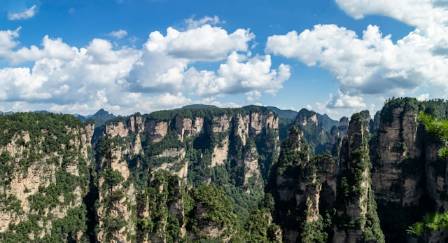
The Zhangjiajie Forest Park is located in Wulingyuan District, Zhangjiajie City, Hunan Province, specifically along Jinbian Road No. 279. The protected area covers approximately 48.1 square kilometers, also described as about 5,000 hectares.
Ella Brooks
Temple note
Layer tip
The full corridor digest continues below along soft meter ticks.
Path
Temple Corridor
The Zhangjiajie Forest Park is located in Wulingyuan District, Zhangjiajie City, Hunan Province, specifically along Jinbian Road No. 279. The protected area covers approximately 48.1 square kilometers, also described as about 5,000 hectares.
The park was officially approved by the State Council of China on September 25, 1982. It experiences a humid subtropical monsoon climate, with an average annual temperature around 17°C, though some sources list it between 12–15°C depending on elevation and microclimate variations.
Geological and Landscape Features
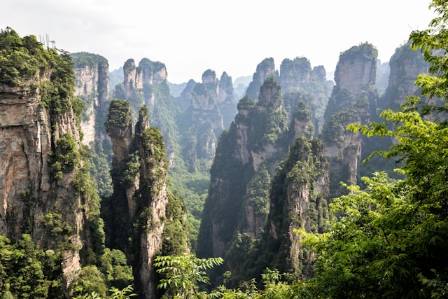
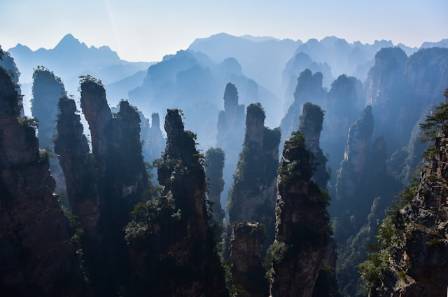
The park lies within the central section of the Wuling Mountain range. It is famous for its extraordinary landscape of more than 3,000 quartz sandstone pillars, shaped over time by water erosion, gravity-induced collapse, and natural weathering processes.
The underlying geology consists mainly of near-horizontal Middle Devonian quartz sandstone formations, which contribute to the region’s distinctive vertical rock structures and dramatic scenery.
Ecology and Natural Diversity
Forest coverage in the park is extremely high, reaching about 97.7%. The dominant vegetation includes mixed evergreen and deciduous broadleaf forests.
The region hosts around 517 species of woody plants from 93 different plant families. Notable protected species include ginkgo, hemlock spruce, and Chinese yew.
Wildlife is also diverse, with 27 recorded mammal species such as macaques and giant salamanders, along with 41 bird species across multiple taxonomic groups.
Major Scenic Areas
Huangshizhai is known for misty landscapes and formations such as the Golden Turtle and Five-Finger Peak.
Jinbianxi (Golden Whip Stream) features clear waters flowing through towering cliffs and is also known as a filming location for classic Chinese productions such as Journey to the West.
Yuanjiajie is one of the most famous zones, home to landmarks like the Back Garden, Lost Soul Platform, and the First Bridge Under Heaven. It is also widely believed to have inspired the floating mountains in the film Avatar.
Yangjiajie is characterized by steep trails and relatively untouched natural scenery, offering a more rugged hiking experience.
Tianzishan (Heavenly Son Mountain) includes viewpoints such as the Imperial Brush Peak and Fairy Offering Flowers.
Suoxiyu Valley is known for its mist-filled waterways and river-like formations weaving through the landscape.
Visitor Information
The most suitable times to visit are spring (March to May) and autumn (September to November), when weather conditions are generally mild and visibility is best.
Operating hours vary seasonally. From March 1 to November 30, the park is open from 07:00 to 18:00, with last entry at 16:00. From December 1 to February 28, hours are shortened to 08:00 to 17:00.
Ticket prices differ depending on the area and season. The Wulingyuan core scenic zone costs approximately 224 yuan per person. For Zhangjiajie National Forest Park specifically, peak season admission is around 165 yuan, while off-season tickets are about 84 yuan per person.
Awards and International Recognition
In 1992, the site was listed as a UNESCO World Natural Heritage location due to its unique quartz sandstone peak formations.
In 2004, it was officially designated as a World Geopark in China. By 2007, it had also received the AAAAA tourism rating, the highest classification for scenic attractions in the country.
Summary
Zhangjiajie National Forest Park in Hunan Province represents one of China’s most remarkable natural landscapes. With its dramatic sandstone pillars, rich biodiversity, and international recognition, it stands as a premier destination for travelers interested in geological wonders and scenic exploration.
More along this corridor
MID · en

Stoat facts and control tips
Stoats, together with ferrets and weasels, were brought to New Zealand during the late nineteenth century in an attempt to reduce the rapidly growing rabbit population. Local scientists, including the well-known ornithologist Walter Buller, warned authorities about the possible consequences, but their concerns were not acted upon.
MID · en

The Hidden Health Benefits of Golf
For many people, golf is not simply a recreational activity—it becomes a lifestyle. Whether someone plays casually on weekends, competes in club tournaments, or just enjoys time outdoors on the fairway, golf provides far more than the satisfaction of hitting a clean shot. Modern research indicates that it supports physical fitness, mental alertness, and social interaction, all of which contribute to healthier and longer lives (Sorbie et al., 2022).
MID · en
Monet Haystacks Series
Claude Monet’s Haystacks series is one of the clearest demonstrations of his lifelong fascination with capturing light and its shifting effects on objects and landscapes. Through repeated observation of the same subject, Monet explored how illumination transforms color, atmosphere, and perception across different times of day and changing seasons.
MID · en
9 Must-See Attractions at Bollywood Parks Dubai You Can’t Miss
If you're heading to Dubai and want a unique experience that blends theme park thrills with the color, energy, and drama of Indian cinema, Bollywood Parks Dubai is the place to be. Spanning 1.7 million square feet, it’s the world’s first theme park dedicated entirely to Bollywood, bringing the magic of Hindi movies to life with shows, rides, and immersive experiences. To help you make the most of your visit, here are nine unmissable attractions inside the park.
MID · en

Painting a Dolphin with Primary Colors
painting with acrylics is a great way to experiment with color blending, mixing, and creative ideas.
MID · en

Exciting possibilities with digital human modelling
The combination of artificial intelligence, computational modeling, and simulation has significantly improved the ability to test “what-if” scenarios during product development across many industries. A central technology enabling this is Digital Human Modelling (DHM), which uses computer-generated representations of humans with realistic physical traits and behavioral characteristics.