
Corridor read
Six Winter Scenes in Art
Winter in the northern hemisphere brings short days, biting winds, frosty paths, and cozy knitwear. It marks the end of one year and the beginning of another, a season of reflection and transition.
Jordan Vale
Temple note
Layer tip
The full corridor digest continues below along soft meter ticks.
Path
Temple Corridor
Winter in the northern hemisphere brings short days, biting winds, frosty paths, and cozy knitwear. It marks the end of one year and the beginning of another, a season of reflection and transition.
Winter has long inspired artists. Some express human emotions through ice, snow, and mist, while others focus on realistic depictions, from the soft morning light on frost-covered trees to snow-laden city streets. In the twentieth century, many artists began exploring the season through abstract approaches, capturing the mood and essence of winter in new ways.
Here is a selection of works from our collection that showcase the diverse ways artists have interpreted winter.
Peter Doig, Ski Jacket (1994)
A newspaper photograph of beginner skiers on a Japanese mountain sparked Peter Doig’s creation of this painting. He frequently paints snow scenes because, in his words, snow “draws you inward, often evoking nostalgia, imagination, and reflection.” The painting captures a quiet, contemplative mood within the snowy landscape.
Wilhelmina Barns-Graham, Glacier Crystal, Grindelwald (1950)
Winter has inspired artists to explore colors, forms, and textures that evoke the season. These abstract works are often informed by real experiences and landscapes.
Barns-Graham painted this piece after visiting the Grindelwald Glacier in Switzerland. She was captivated by its immense scale, the way light played across its surface, and the contrast between its solidity and glass-like transparency. Her abstraction conveys the grandeur and mystique of the glacier.
Marie-Louise von Motesiczky, View from the Window, Vienna (1925)
What better way to paint on a cold winter day than from inside, observing the season through a window? The artist can capture the frosty exterior while remaining warm.
This work depicts the view from von Motesiczky’s fourth-floor flat in Vienna (the distant dome belongs to the now-demolished Johann Strauß-Theater). She uses the window frame and curtain to guide the composition. Snow-covered buildings are rendered with loose brushstrokes in muted grays and soft pinks, creating a calm and fresh winter atmosphere. The artist noted that this style was new for her, inspired by the striking freshness of snow in the city.
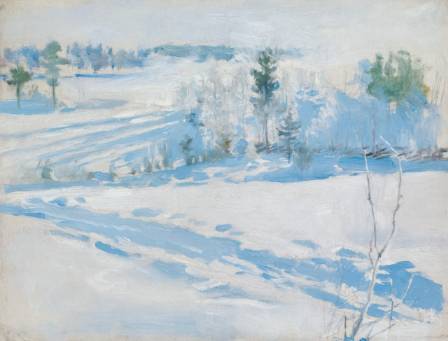
Tacita Dean, Majesty (2006)
Tacita Dean’s painting was inspired by her photograph of the majestic Fredville oak tree in Kent, one of England’s largest and oldest complete oaks. She painted the surrounding area in white to isolate the bare branches and trunk, emphasizing its form. The weathered tree stands as a symbol of time passing, endurance, and strength, having survived many winters and poised to withstand many more.
Stanislawa De Karlowska, Berkeley Square (c.1935)
De Karlowska painted several works depicting London’s central squares. This piece captures a winter evening in Berkeley Square.
Street lamps illuminate the nearly empty streets, with only two women walking toward a waiting taxi. Viewed from a high vantage point, the painting conveys the isolation of urban life. Observers, like the artist, look down on the fleeting world of the square, feeling both distance and quiet intimacy.
Briton Rivière, Beyond Man’s Footsteps (exhibited 1894)
Animal painter Briton Rivière was inspired by Charles Darwin’s ideas on evolution and the connection between humans and animals.
This dramatic icy scene portrays the Arctic as a place of sublime beauty and extreme conditions. No humans are present; a polar bear dominates the scene. Rivière painted this from imagination, using explorers’ written accounts for reference, while the bear was modeled after one at the London Zoo. The work emphasizes the power and majesty of nature in its untouched state.
Together, these works demonstrate how artists have captured winter in its many forms—from realistic urban and natural landscapes to abstract explorations of color, shape, and atmosphere.
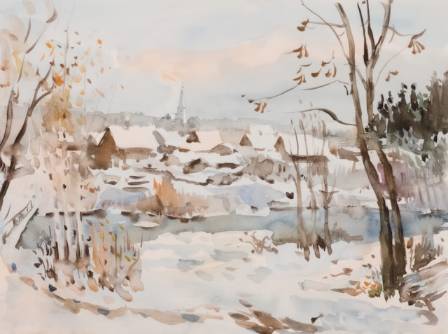
More along this corridor
MID · en

Oriental Pearl Tower
Standing at 468 meters tall, the Shanghai Oriental Pearl TV Tower is one of the most famous landmarks in Shanghai. It ranks as the fourth tallest tower in Asia and the sixth tallest tower of its kind in the world. Construction began on July 30, 1991, and the tower was officially completed on October 1, 1994.
MID · en
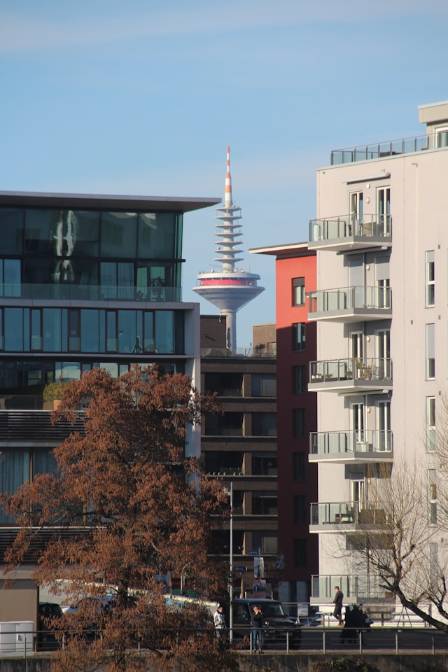
The Europaturm in Frankfurt
Standing tall in the heart of Frankfurt, the Europaturm is one of the city’s most recognizable landmarks. Often referred to as the "European Tower," this impressive structure dominates the skyline and serves as a key telecommunications hub. Its unique design and historical significance make it a point of interest for both locals and visitors.
MID · en
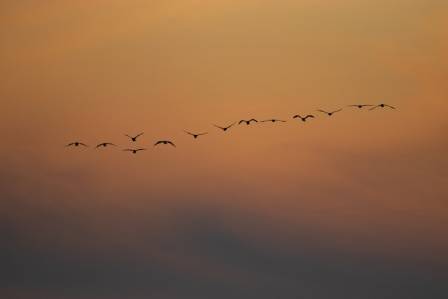
Dawn chorus(birds)
The dawn chorus is a natural phenomenon where birds sing at the start of a new day, typically during spring in temperate regions. This behavior is most noticeable in the early morning hours when birds are either defending their breeding territories, attracting mates, or calling to their flocks.
MID · en
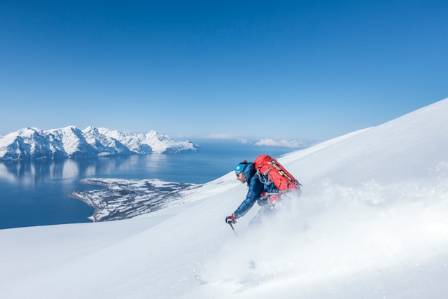
Top 5 Highest Ski Resorts in the World
Top 5 Highest Ski Resorts in the World
MID · en

Why does the ocean have waves?
The sea is constantly in motion. Whether you are watching from the shoreline or looking out from a boat, waves are an expected part of the ocean view. Waves form when energy moves through water, making it travel in a circular pattern. However, the water itself does not move across the ocean with the wave. Instead, waves carry energy from one place to another, and when there are no barriers in their path, they can cross an entire ocean basin.
MID · en
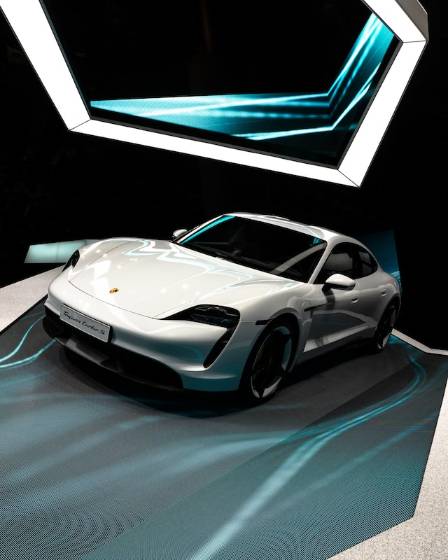
The Pinnacle of Electric Luxury: Unveiling the Finest Electric Cars
The automotive landscape is undergoing a seismic shift, reminiscent of the revolutionary moment when Carl Benz introduced the first motorcar in 1886. The transition from fossil fuels to electric power is reshaping the industry, fueled by a global commitment to combat climate change. With governments mandating a shift towards electric vehicles (EVs), the market is flooded with choices. Let's explore the epitome of luxury in the electric realm, featuring the finest EVs currently available.